 Numerology
Pythagorean Numerology
A deep look at the system behind your portrait.
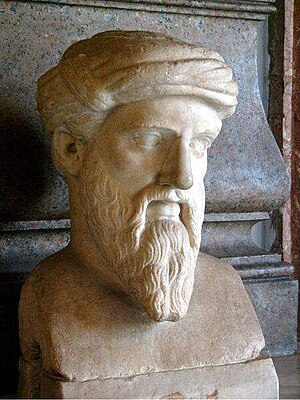
Pythagoras Bust, c. 500 BC
Capitoline Museums, Rome, Italy
Listen to this page
0:00
History
Pythagorean numerology traces its roots to Pythagoras of Samos (c. 570 - 495 BCE), the Greek philosopher and mathematician best known for the Pythagorean theorem. But Pythagoras was far more than a geometer. He founded a secretive philosophical school in Croton, southern Italy, built on the conviction that numbers are the fundamental substance of reality — that the universe, at its deepest level, is mathematical.
For Pythagoras and his followers, numbers were not abstract accounting tools. They were living archetypes. The number 1 represented unity and origin. The number 2 represented duality and tension. The number 3 was harmony — the resolution of opposites. Each number carried a qualitative character as much as a quantitative one. This idea — that numbers have meaning beyond quantity — is the philosophical seed of all numerology.
The system that bears his name maps the Latin alphabet to the digits 1 through 9 in sequential order (A=1, B=2, ... I=9, J=1, K=2, and so on). This mapping was formalized centuries after Pythagoras by later practitioners who married his number philosophy with alphabetic systems. By the early 20th century, modern Pythagorean numerology had taken its current shape through authors like L. Dow Balliett and Juno Jordan, who codified the calculations — Life Path, Destiny, Soul Urge — that we use today.
Unlike Chaldean numerology (which uses a different letter-number mapping and considers the number 9 sacred and unassignable), the Pythagorean system is symmetrical and straightforward: every letter maps to one of nine digits, and every calculation reduces to a single digit or a master number (11, 22, 33). This simplicity is part of its enduring appeal.
Why Does It Seem to Work?
Numerology is not a science in the empirical sense. There is no controlled study demonstrating that people born on the 7th are statistically more introspective than people born on the 3rd. And yet, many people find their numerological portraits uncannily accurate. Why?
There are several plausible explanations, and they are not mutually exclusive.
The Barnum Effect
Named after showman P.T. Barnum, this is the psychological phenomenon where people accept vague, general personality descriptions as uniquely applicable to themselves. When a reading says "you sometimes feel misunderstood," nearly everyone nods. Good numerological writing is more specific than pure Barnum statements, but the effect still plays a role in why readings feel personally resonant.
Seasonal and Environmental Influences
Your birth date is not entirely arbitrary. Children born in different months experience different early-life conditions: seasonal sunlight exposure, vitamin D levels, maternal nutrition during pregnancy, relative age within school cohorts, and even local disease patterns. Some research suggests these factors can nudge developmental outcomes in statistically detectable ways. A winter-born child may develop slightly different social patterns than a summer-born child — not because of mystical vibrations, but because of measurable environmental inputs. Numerology's birth date calculations may loosely correlate with these real patterns.
Name as Identity Anchor
Your name is one of the first things you hear, thousands of times in early childhood. It shapes how others perceive you and, through that, how you perceive yourself. Names carry cultural, ethnic, generational, and phonetic associations. A "Victoria" and a "Breezy" grow up hearing subtly different expectations embedded in their names. Numerology's name-based calculations (Destiny, Soul Urge, Personality) may capture some of these real — if indirect — identity influences.
Archetypal Resonance
Carl Jung proposed that the human psyche contains universal patterns — archetypes — that recur across cultures. His work inspired frameworks of twelve core archetypes (the Innocent, the Hero, the Sage, the Explorer, the Rebel, the Magician, the Lover, the Caregiver, the Jester, the Ruler, the Creator, and the Everyman), each representing a fundamental mode of human experience. Numerology works with a parallel set: nine single-digit archetypes plus three master numbers (11, 22, 33), each carrying its own distinct character. When you encounter your number's description, you may recognize a pattern you already live but haven't named. The framework gives language to something you already sense about yourself, which makes it feel like a revelation rather than an imposition.
Reflective Self-Modeling
Perhaps the deepest reason numerology "works" is that any structured framework for self-reflection can be valuable. Numerology provides a vocabulary and a set of prompts: What drives you? What do you show the world? What do you hide? These are real questions with real answers, and the numerological framework simply provides scaffolding for thinking about them. In this sense, numerology is less a prediction system and more a mirror — one that reflects different facets depending on which number you examine.
The Base Numbers
These are the core calculations that appear at the top of every Numerology Portal portrait. Each one illuminates a different dimension of your personality, path, and potential.
Life Path Number
Derived from your full birth date
The most important number in your chart. Your Life Path represents the broad trajectory of your life — the themes, lessons, and opportunities you are here to experience. It is calculated by reducing your birth month, birth day, and birth year each to a single digit (or master number), then summing those three values and reducing again. For example, someone born on March 15, 1990 would reduce 3 + 6 + 19 = 28, then 2 + 8 = 10, then 1 + 0 = 1. Their Life Path is 1. (You can run this calculation on your own date with our free numerology calculator.)
Destiny Number (Expression)
Derived from all the letters in your full birth name
Your Destiny Number reveals your inherent talents, abilities, and the goals you are meant to pursue. It represents what you are here to accomplish. Each name in your full birth name is converted to numbers using the Pythagorean letter chart (A=1, B=2, ... I=9, J=1, etc.), reduced independently, then summed and reduced to a final digit. This number reflects the full scope of your potential as expressed through the name you were given.
Soul Urge Number (Heart's Desire)
Derived from the vowels in your full birth name
Your Soul Urge reveals your innermost desires — what truly motivates you at the deepest level, beneath social expectations and public persona. It is calculated using only the vowels in your name (A, E, I, O, U, and Y). This is the part of you that only your closest intimates may fully see: what you long for, what satisfies you, and what feels like home.
Personality Number
Derived from the consonants in your full birth name
Your Personality Number describes how you present yourself to the world — the outer mask, first impression, and social style that others perceive before they know you well. It is calculated using only the consonants in your name. Think of it as the front door to your house: it's what visitors see first, even though the interior (your Soul Urge) may look entirely different.
Maturity Number
Derived from your Life Path + Destiny numbers
Your Maturity Number represents the person you are becoming — the themes and qualities that emerge more strongly in the second half of life, typically after age 35-40. It is the sum of your Life Path and Destiny numbers, reduced to a single digit. This number reflects a kind of integration: the blending of who you inherently are (Life Path) with what you are meant to express (Destiny) into a mature, unified self.
Balance Number
Derived from the initials of your name
Your Balance Number reveals how you instinctively handle conflict, stress, and emotional upheaval. It is calculated from the first letter of each name in your full birth name. This number activates most strongly during challenging periods, pointing to your default coping mechanism and the approach that will serve you best when life demands resilience.
Hidden Passion Number
The most frequently occurring digit in your name
Your Hidden Passion reveals your strongest natural talent or drive — the area where you have the most innate energy and ability. It is determined by finding which digit (1-9) appears most frequently when all the letters in your name are converted to numbers. This number indicates where your enthusiasm naturally flows and where you are most likely to excel without conscious effort.
Subconscious Self Number
Count of distinct digit values (1-9) present in your name
Your Subconscious Self reveals your confidence and readiness to handle life's unexpected situations. It is simply the count of how many of the nine possible digits appear at least once in your name. A higher number (8 or 9) indicates broad inner resources and composure under pressure. A lower number suggests specific areas where you may feel less prepared and need conscious development.
Personal Year Number
Derived from your birth month, birth day, and the current calendar year
Your Personal Year number describes the overarching theme and energy of the current twelve-month cycle. It runs in a repeating nine-year cycle: 1 years are about new beginnings and initiative, 5 years bring change and freedom, 9 years are about completion and release. Knowing your Personal Year helps you understand whether this is a time to push forward, consolidate, or let go — and it shifts every calendar year.
Letter Analysis (Premium)
These three letter-based calculations appear exclusively in Premium portraits. They examine the specific letters in your name for additional personality insights.
Cornerstone (Premium)
The first letter of your first name
Your Cornerstone reveals how you approach new situations, begin projects, and initiate action. It is simply the first letter of your first name — the letter that introduces you to the world. Each letter carries the energy of its corresponding number: an "A" Cornerstone (1) suggests bold, independent initiative, while an "S" Cornerstone (1) adds a more emotional, intense starting energy. The Cornerstone shapes your instinctive first response to any new challenge or opportunity.
Capstone (Premium)
The last letter of your first name
Your Capstone reveals how you finish what you start — your follow-through, closure style, and ability to bring things to completion. It is the last letter of your first name. Where the Cornerstone shows how you begin, the Capstone shows how you end. A "D" Capstone (4) suggests methodical, determined completion, while an "E" Capstone (5) suggests a more restless, adaptable approach to wrapping things up. Together, your Cornerstone and Capstone paint a picture of your entire project arc — from initiation to resolution.
First Vowel (Premium)
The first vowel in your first name
Your First Vowel reveals your instinctive, gut-level reaction to people and situations — the inner response that occurs before conscious thought kicks in. Vowels represent the inner self (they form the basis of the Soul Urge), and the first vowel in your first name is the most immediate expression of that inner world. An "A" First Vowel suggests an instinct toward independence and action, while an "O" suggests an instinct toward responsibility and emotional depth. This number illuminates the filter through which you first process every experience.
Additional Calculations
Beyond the base numbers, your portrait may include these supplementary calculations for a more complete picture.
Karmic Debt Numbers
Certain numbers — 13, 14, 16, and 19 — carry special significance when they appear as intermediate values in your Life Path, Destiny, Soul Urge, or Personality calculations. These are called Karmic Debt numbers and suggest unresolved lessons from prior experiences (or, if you prefer a non-metaphysical framing, deeply embedded behavioral patterns that require conscious effort to overcome). Each Karmic Debt number points to a specific pattern: 13 relates to shortcuts and laziness, 14 to overindulgence and control, 16 to ego and self-destruction, and 19 to selfishness and isolation.
Karmic Lessons
Your Karmic Lessons are the digit values (1-9) that do not appear anywhere in your full birth name. These missing numbers indicate qualities you have not yet developed and areas where growth will feel uncomfortable but rewarding. For example, if the number 8 is absent from your name, you may struggle with authority, financial management, or asserting personal power — and those are the exact areas where life will push you to grow.
Challenge Numbers
Your four Challenge Numbers are derived from the differences between your reduced birth month, birth day, and birth year. They represent the obstacles, weaknesses, and internal conflicts you must confront at different stages of life. The First Challenge governs youth, the Second covers early adulthood, the Third (and most impactful) spans midlife, and the Fourth runs through the later years. Unlike most numerological values, Challenge Numbers are found by subtraction — highlighting what is missing or underdeveloped rather than what is present.
Pinnacle Numbers
Your four Pinnacle Numbers are the counterpart to your Challenges — they represent the opportunities, achievements, and environments that define each major phase of life. Calculated from the sums (rather than differences) of your birth date components, Pinnacles describe what is available to you during each period. The First Pinnacle typically covers birth to the mid-thirties, the Second and Third each span nine years, and the Fourth extends through the rest of your life. Together, your Pinnacles map the arc of your external circumstances and potential accomplishments.
The Master Numbers
In Pythagorean numerology, three numbers — 11, 22, and 33 — are considered Master Numbers. When these appear in the reduction process for your Life Path, Destiny, Soul Urge, Personality, or Maturity calculations, they are not reduced further. They represent heightened vibrations of their single-digit roots (2, 4, and 6 respectively) and carry both greater potential and greater tension.
Master Number 11 amplifies the qualities of 2 — intuition, sensitivity, partnership — into visionary insight, spiritual awareness, and nervous intensity. It is sometimes called the "Illuminator."
Master Number 22 amplifies the qualities of 4 — structure, discipline, building — into large-scale manifestation and the ability to turn ambitious visions into tangible reality. It is called the "Master Builder."
Master Number 33 amplifies the qualities of 6 — nurturing, responsibility, service — into selfless teaching, healing, and spiritual upliftment. It is called the "Master Teacher" and is the rarest of the three.
Carrying a Master Number is not inherently "better" than carrying a single digit. Master Numbers come with heightened expectations and internal pressure. Many people with Master Numbers in their charts experience significant inner tension between the higher calling of the master vibration and the simpler, more grounded pull of the single-digit root.
The Pythagorean Letter/Number Chart
This is the mapping used to convert letters to numbers in all name-based calculations. Tap any number in the header row to learn what that number symbolizes.
| A | B | C | D | E | F | G | H | I |
| J | K | L | M | N | O | P | Q | R |
| S | T | U | V | W | X | Y | Z |
Deep dives
Long-form companion pages on the topics most-asked about by our users.
Life Path Number Meaning & Calculation
The single most important number in your chart, with a worked Pythagorean calculation for every digit.
Tap to learn more →Click to learn more →
Master Numbers 11, 22, and 33
11, 22, and 33 explained in depth: their root tensions, when they actually apply, and what carrying one feels like.
Tap to learn more →Click to learn more →
Soul Urge Number Meaning & Calculation
What you actually want underneath the public version of you — calculated from the vowels in your birth name.
Tap to learn more →Click to learn more →
Destiny Number (Expression) Meaning & Calculation
Your Destiny / Expression number: the talents and outer purpose written into your full birth name.
Tap to learn more →Click to learn more →
Numerology Compatibility — How Two Charts Fit
Which numbers actually matter when comparing two charts, and which combinations tend to harmonize or clash.
Tap to learn more →Click to learn more →
Numerology vs Astrology — How They Differ
Two systems often shelved together that actually do different work with different inputs.
Tap to learn more →Click to learn more →
Pythagorean vs Chaldean Numerology
The two main letter-to-number systems compared — and why this site uses Pythagorean.
Tap to learn more →Click to learn more →
Personal Year Number — Meaning & Calculation
The nine-year cycle that names the theme of your current calendar year, with the calculation step by step.
Tap to learn more →Click to learn more →
Name Changes in Numerology — What Actually Shifts
Marriage, legal changes, stage names — which numbers actually change and which stay locked to the birth certificate.
Tap to learn more →Click to learn more →
Karmic Debt Numbers — 13, 14, 16, and 19
13, 14, 16, and 19 explained — where they appear, what each pattern points to, and how to work with them.
Tap to learn more →Click to learn more →
Numerology Glossary — Terms You'll See in a Portrait
Plain-English definitions for every term you'll see across portraits — bookmark and refer back.
Tap to learn more →Click to learn more →
Common Numerology Myths — Debunked
The most common misconceptions about numerology — and what the system actually says.
Tap to learn more →Click to learn more →